Late last month I spoke at Czech Dreamin in Prague. My session was about Lightning Web Components — architecture patterns that scale beyond a single component: cross-DOM messaging, parent-child orchestration, the kind of thing you reach for when an app outgrows a tidy little tree of components.
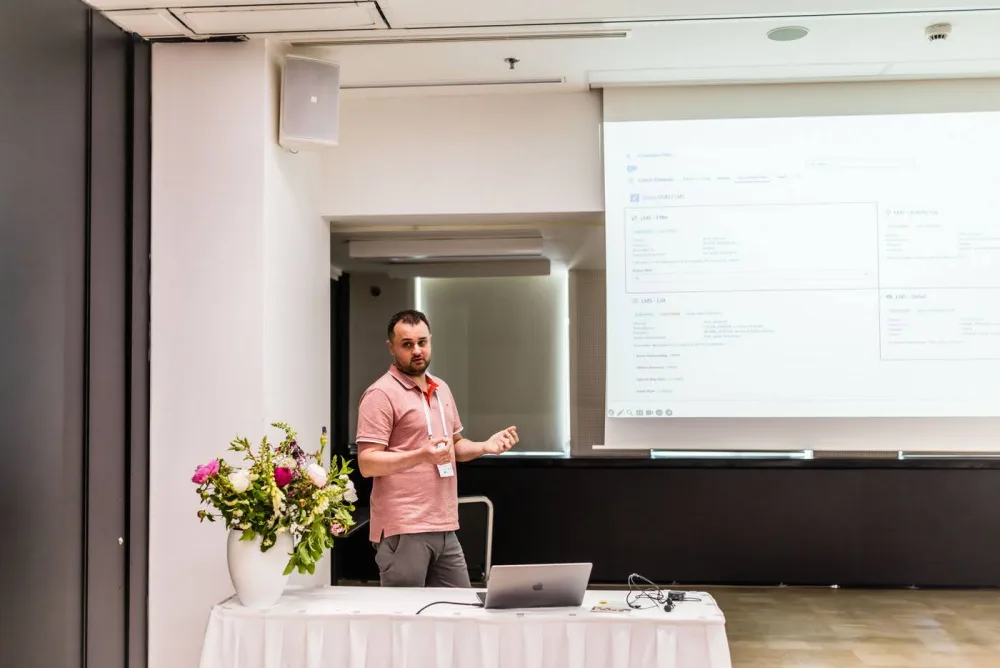
The talk went well. But it’s not what I remember most about the day.
The real conference happens in the hallway
If you’ve been to a community event, you know the sessions are only half the value. The other half is the hallway track — coffee in hand, badge slightly crooked, talking shop with people who actually do this work. That’s where I spent most of Czech Dreamin, and that’s where something kept happening.
I’d start a conversation about components, or AppExchange, or whatever was on the slide ten minutes earlier. And within a few minutes, almost every conversation drifted to the same place: their data is a mess, and it’s starting to hurt.

Not in the abstract “we should clean up the org someday” way. In the specific, this-is-blocking-us-right-now way.
The same five problems, over and over
Once I started paying attention, the pattern was almost funny. Different industries, different org sizes, different tech stacks — but the symptoms rhymed:
- Duplicates nobody trusts. Three Accounts for the same company, two of them with half the fields filled in. Sales doesn’t know which one is real, so they create a fourth.
- Incomplete records. Required-at-the-business-level fields that were never required in Salesforce, so 40% of Contacts have no email and reporting quietly lies.
- Stale data. Lead statuses from 2023, “last activity” dates that predate half the team, opportunities that should have closed a year ago.
- Inconsistent values. “USA”, “U.S.A.”, “United States”, “us” — five spellings of one country, and every dashboard that groups by region is wrong.
- PII hiding in plain sight. Personal data in description fields, notes, and free-text everywhere — invisible until someone goes looking, or until it leaks.
None of this is new. Salesforce teams have lived with messy data forever. What was new was the urgency — and the reason for it.
Agentforce changed the stakes
Almost every one of these conversations had the same subtext. People aren’t worried about data quality because a dashboard looks off. They’re worried because leadership wants AI, and Agentforce is suddenly on the roadmap.
And here’s the thing about AI on top of Salesforce: it doesn’t politely ignore your bad data the way a human rep learns to. It confidently acts on it. An agent that resolves the wrong duplicate, emails a stale contact, or summarizes an Account from half-empty fields doesn’t fail loudly — it fails plausibly. That’s worse.
The line I kept coming back to in those conversations is one we put front and center in the product I’ve been building: your Agentforce is only as reliable as the data behind it. Most teams discover this too late — after the pilot produces a confidently wrong answer in front of an executive.
Why this is exactly what we built DQS for
I’ll be honest: standing in that hallway hearing the same problem five times in an afternoon was the best product validation I’ve had in a long time. Because it’s precisely the problem Data Quality Sense (DQS) exists to solve.

The idea is simple: you can’t fix what you can’t measure, and most orgs have never actually measured their data quality. DQS does that, natively inside Salesforce:
| Dimension | What it surfaces |
|---|---|
| Completeness | Records missing the fields your processes actually depend on |
| Duplication | The duplicate clusters eroding trust in your data |
| Consistency | The “USA / U.S.A. / United States” problem, quantified |
| Freshness | Records that have gone stale and shouldn’t be trusted |
| Validity | Values that break format or business rules |
| PII exposure | Sensitive data sitting where it shouldn’t be |
Across those six dimensions it runs 50+ metrics and rolls everything up into a single AI-readiness score from 0 to 100 — a number you can actually take to leadership and say “this is where we are, and this is what to fix first.”
A few things mattered to me as an architect when we designed it:
- 100% Salesforce-native, zero data export. Everything runs inside your org. Nothing leaves. For most security and compliance teams, that’s the difference between “yes” and a six-week review.
- Affected-record lists with CSV export, so a finding isn’t just a percentage — it’s a worklist someone can actually action.
- A no-code custom rule builder, because every org’s definition of “good data” is a little different.
- Trends over time, so you can prove the cleanup is working instead of hoping it is.
If you want to see where your org stands, there’s a free assessment on the site — it takes about 30 seconds and gives you a score and prioritized recommendations.
The takeaway
I went to Czech Dreamin to talk about component architecture. I left more convinced than ever that the least glamorous layer of the stack — the data underneath everything — is about to become the thing that decides whether all the AI ambition on people’s roadmaps actually works.
Lightning Web Components, clever architecture, Agentforce agents — none of it matters if the data feeding it is duplicated, stale, and half-empty. The orgs that win the next couple of years won’t be the ones with the fanciest agents. They’ll be the ones who measured their data quality first, fixed what mattered, and built on a foundation they could trust.
If you’re eyeing Agentforce, do the unglamorous thing first: measure your data. Everything else is built on top of it.
Comments